Compact vs Full-Size Strollers: Which Fits Your Routine?
The compact stroller folds into a neat little package. The full-size stroller has a basket that looks ready for a proper day out.
Both seem sensible. Both have enthusiastic reviews. And somehow, after another evening of comparing them, you are less sure than when you started.
Here is a better place to begin: picture next Tuesday.
Where will you walk? Will you take the car? Are there stairs between your front door and the pavement? What will you need to carry home?
Those ordinary details are more useful than a category label. This guide compares compact and full-size strollers by the work you need them to do, with practical checks for families hoping to buy one stroller that earns its storage space.
THE QUICK DECISION: Put compact models on your shortlist if carrying and storing the stroller are your main difficulties. Put full-size models on your shortlist if your priority is daily walking and carrying supplies. Then compare actual models: neither label guarantees the features you need.
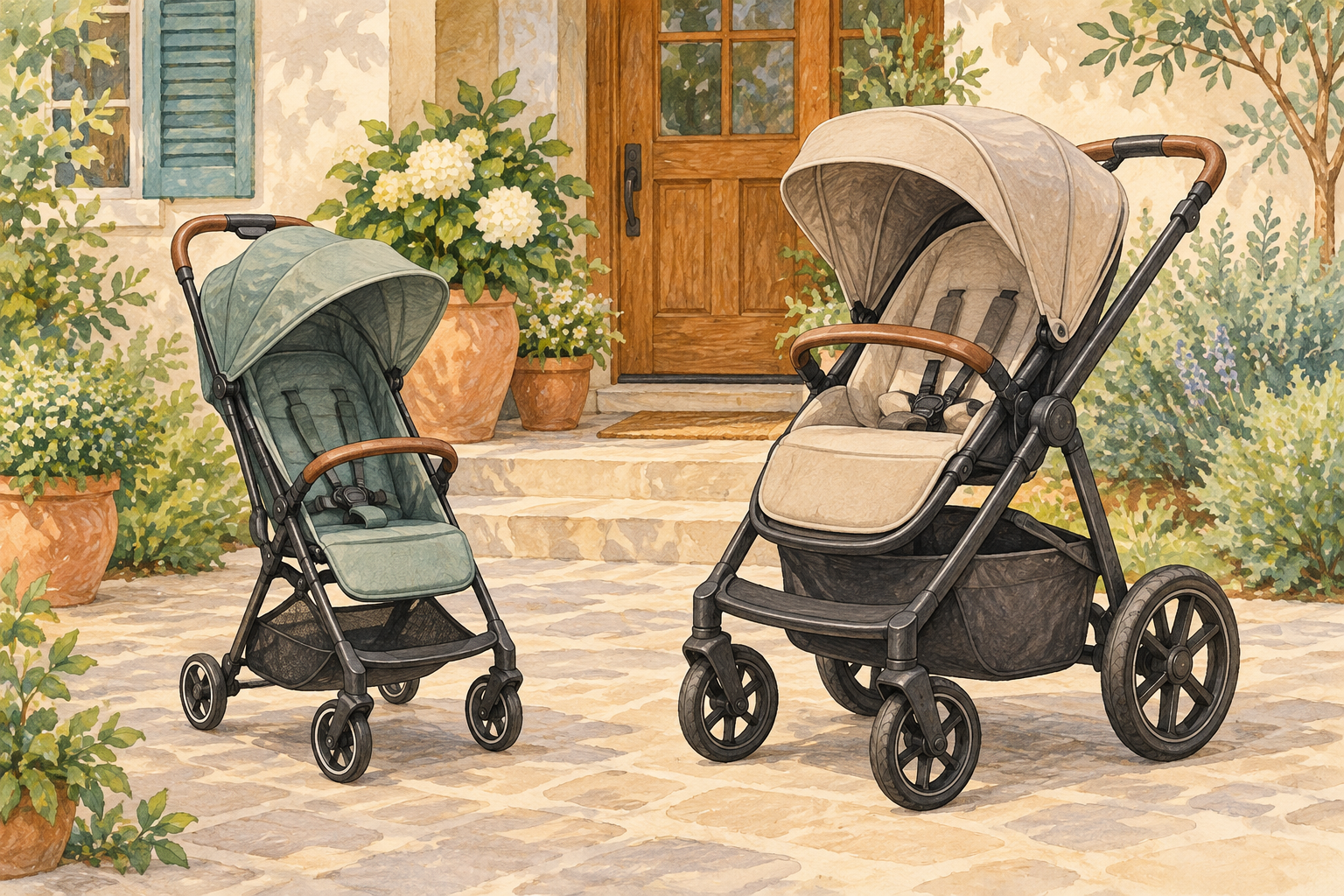
What do “compact” and “full-size” actually tell you?
In everyday shopping, “compact” generally points toward a smaller folded package and portability. “Full-size” usually describes a stroller designed around a more substantial everyday setup.
Those labels are useful starting points, but they are not standardized promises about weight, age suitability, basket capacity, or ride quality.
One compact model may offer a feature another lacks. One full-size model may fold more conveniently for your car than a supposedly travel-focused alternative.
Read the specifications and manual for the exact version sold in your market. If a retailer’s summary disagrees with the manual, resolve the difference before buying.
This is a category decision guide, not a hands-on test or a ranking of individual strollers. The practical comparisons below show what to investigate rather than claiming that every model in a category behaves alike.
Start with your three most frequent outings
Write down the trips you make in an ordinary week. Keep them specific.
“Travel” is broad. “Walk down two flights of stairs, take a bus, and collect groceries on the way home” tells you much more.
Likewise, “suburban family” is not a stroller requirement. “Load the stroller beside a weekly shop, drive to the park, and walk for an hour” gives you something you can test.
Choose your three most frequent outings before thinking about an occasional holiday. You can still plan for travel, but the rare trip should not quietly make every weekday harder.
A simple priority exercise
Give each of these questions an answer: How often will I lift it? Where will it live? What will it carry? What surfaces will I use? What does my child need from the approved setup?
Then circle the two questions that cause the most friction now.
Those are your priorities. A model that wins on a feature you rarely use may still be the wrong purchase for your family.
Scenario 1: Apartment stairs and limited storage
If you carry a stroller up stairs regularly, folded weight and carrying shape deserve serious attention.
A low number on a product page does not tell you whether the handle is comfortable, whether the frame swings against your legs, or whether you can keep a steady grip.
Try carrying a folded demonstration model in a safe area, with permission. Follow its approved carry method. Think through how your child and other belongings will be managed separately during the stair journey.
A compact model may be a promising starting point here, but check the exact weight and fold. Do not assume the word “lightweight” means the same thing to every manufacturer.
Measure the parking space
Look at where the stroller will actually stay: inside a cupboard, beside the door, or in another designated storage area.
Measure that space with the door open and closed. Account for handles, wheels, and the room needed to put the stroller away without blocking access or exits.
If the fold is small but the daily storage routine is awkward, you may stop folding it. The best storage plan is one you can tolerate on a wet evening with groceries.
APARTMENT SHORTLIST: Folded size, approved carry points, actual carrying weight, and a clear storage location. Confirm all four before being distracted by accessories.
Scenario 2: Long walks and errands on foot
For a family that walks most places, the stroller may carry the day’s supplies as often as it carries a tired toddler.
That makes basket access important. Check the manufacturer’s load limit, then see whether your usual bag fits through the opening and can be retrieved without a wrestling match.
A larger-looking basket is not automatically easier to use. Frame bars, seat position, and the shape of your bag all matter.
Full-size models may deserve an early look for this routine, but compare real capacities and handling. There is no category-wide guarantee of a smoother push or more useful storage.
Pay attention to your walking posture
Try the handle position and your normal stride. Ask another regular caregiver to try it too.
Do your feet approach the rear frame? Can you reach the brake comfortably? Is the handle suitable for the people who will actually push it?
These are useful questions for a store visit because dimensions on a page cannot fully answer them. Avoid making the entire choice from a fold demonstration.
Scenario 3: A small car trunk
A stroller can fit in an empty trunk and still be a poor fit for family life.
Try the space with the things that normally share it: shopping bags, an overnight bag, or other everyday equipment. Keep everything secured appropriately for travel.
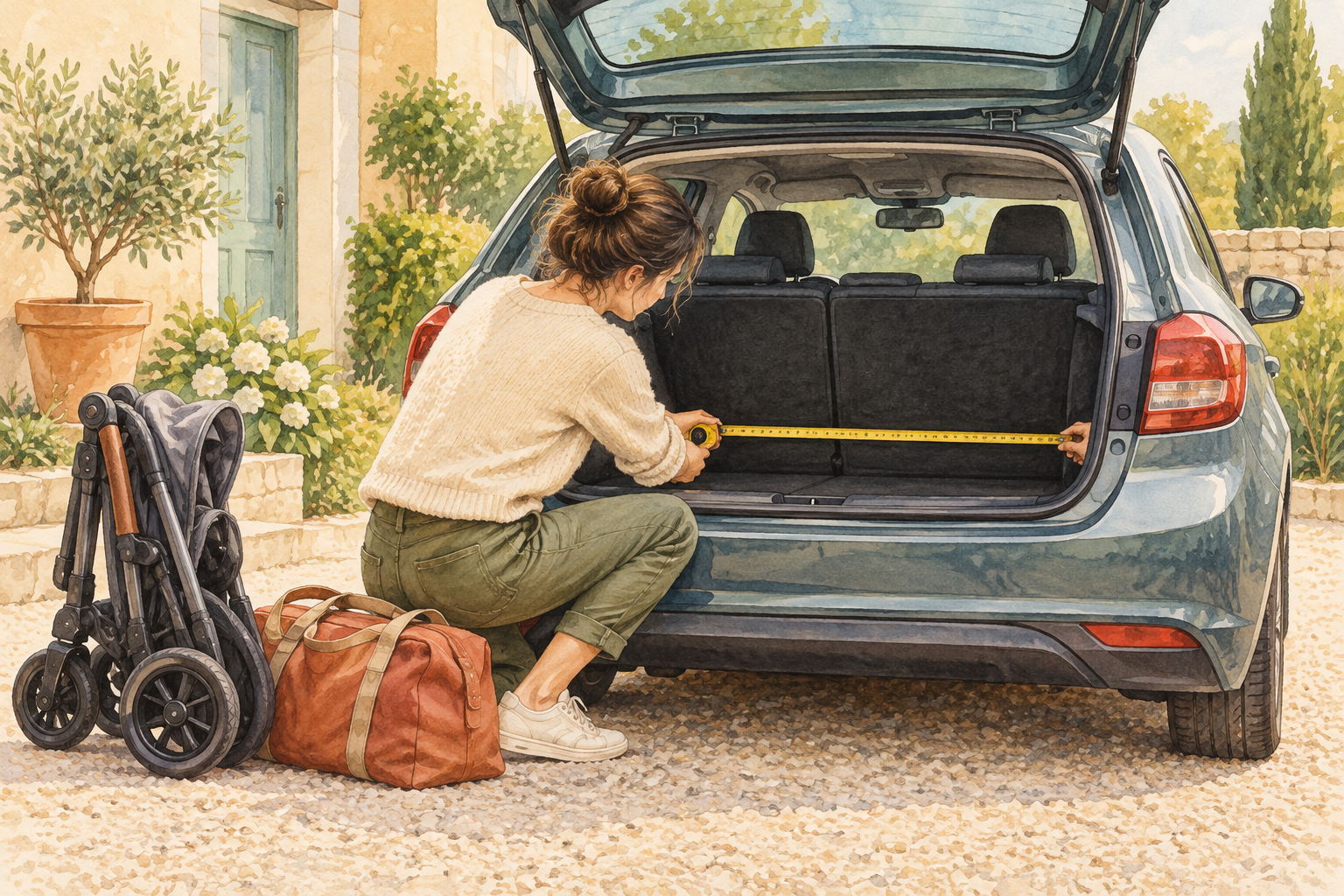
Measure the narrow opening as well as the interior space. A folded frame may have enough room once inside but be awkward to angle through the opening.
If you can test a demonstration model in your vehicle with the retailer’s permission, do it. Otherwise, compare the manufacturer’s exact folded dimensions with your measurements and allow practical clearance.
Think about the whole loading sequence
Where will the stroller sit while you organize the trunk? Can you lift it comfortably using the approved carry point? Does it require a component to be removed each time?
There is nothing inherently wrong with a multi-step fold if it suits you. The question is whether you want to repeat those steps after every errand.
Compact models can make sense when trunk space is the main constraint. A full-size model with a convenient fold may also work. Measure first, then compare.
Scenario 4: Frequent flights and public transport
Portability becomes more important when the stroller is repeatedly folded, lifted, and carried through different environments.
For flights, “compact” does not guarantee cabin acceptance. Read the operating airline’s policy for your actual itinerary and prepare a checking backup.
Official pages such as Delta’s children and infant items guidance and American Airlines’ family travel page are more useful for that decision than a generic “airline-approved” claim in a shopping listing.
For local transport, check the relevant operator’s accessibility and stroller information. Think about the stops and stations you actually use, including whether your route requires stairs or a folded stroller.
Do not buy only for the airport
Imagine arriving at your destination and using the stroller for several days. Will its storage, permitted setup, and practical handling fit the outings you have planned?
A tiny folded package can be valuable, but it is only one part of the trip.
If you fly rarely, ask whether your existing stroller can make the journey under the airline’s rules. A second stroller is an option, not a requirement created by booking a flight.

Compare terrain needs without trusting the label
Think about the surfaces on your usual route: smooth indoor floors, uneven sidewalks, gravel paths, or repeated curb transitions.
Wheel design and other features can matter, but you cannot confidently rank handling from the category name or a photograph. Look for relevant, well-described testing of the exact models and try them in permitted conditions where possible.
A store floor can reveal basic steering and fit. It does not prove how a stroller performs on your local broken pavement.
Check the manufacturer’s intended use. Do not assume a full-size stroller is suitable for running or rough terrain, and do not use any stroller outside its instructions.
The CPSC’s stroller information explains the safety-standard context. It is not a performance ranking or proof that a particular stroller meets your terrain needs.
Your child’s fit comes before the fold
Before comparing convenience, confirm that the exact stroller configuration is approved for your child’s current age, size, and developmental stage.
Some setups require a specific approved attachment or have limits that are easy to miss in a short retailer description. Read the manufacturer’s instructions and include necessary approved components in your cost and storage comparison.
Check the harness adjustment and how easily you can buckle it correctly. Consider the seat and footrest arrangement within the manufacturer’s limits.
Do not treat a reclining seat as a substitute for an approved sleep space. For infant sleep guidance, use the American Academy of Pediatrics’ safe-sleep information.
This is one place where a convenient fold cannot compensate for a mismatch. Remove unsuitable models from the list before comparing colors, baskets, or travel accessories.
Can a travel stroller be your everyday stroller?
It can be a candidate if the exact model fits your child and daily needs within its instructions. “Travel” on the label does not prevent everyday use, but it does not prove everyday suitability either.
Run it through your three ordinary outings. If you walk to daycare, visit a shop, and store it in a small hallway, judge those tasks directly.
You may find that its portability solves your biggest problem. You may also discover that limited storage or an inconvenient handle makes the daily routine less pleasant.
The answer should come from the model and your routine, not from the assumption that every family eventually needs a larger stroller.
ONE-STROLLER TEST: Could you comfortably choose this stroller for your most common outing tomorrow? If the answer is only “It will be great for our trip in six months,” keep looking.
Do you need both a compact and a full-size stroller?
Some families find two strollers useful because their routines have genuinely different demands. Others end up storing an expensive backup that rarely leaves the house.
Before buying a second one, name the problem it would solve. “Easier to carry on weekly train trips” is specific. “It might come in handy” is harder to justify.
Include the purchase price, approved accessories, storage space, and maintenance in the decision. If you are considering borrowing or renting for an occasional trip, verify the exact model, condition, instructions, and suitability.
A second stroller should make a recurring task easier or solve a clear temporary need. You do not need one simply because another family’s setup looks complete.
Compare total cost, not just the price tag
Put the actual setups side by side. Include any approved components needed for your child, weather accessories you will use, and transport accessories that genuinely fit your plans.
Then check what comes in the box. A cheaper base price can become less attractive after necessary additions, while an expensive bundle may contain things you will never use.
Look at warranty terms, replacement parts, and support information. These details do not tell you everything about durability, but they help you understand ownership beyond checkout.
If buying used, identify the exact model and check the CPSC recall database, the manufacturer’s guidance, condition, and completeness before use.
Do not assume resale value will make an over-budget purchase affordable later. Treat any future resale as uncertain rather than money already back in your pocket.
A ten-minute comparison you can do in a store
Bring your shortlist, your measurements, and the bag you usually carry. Ask permission to try the features that matter to your routine.
Start with child suitability and the approved setup. Then work through the same sequence on each model so your impressions are easier to compare.
- Push at your normal walking pace and check handle fit.
- Try the brake and harness according to the demonstration instructions.
- Place your usual bag in the basket within the stated load limit.
- Fold and reopen the stroller using the correct sequence.
- Lift the folded stroller using its approved carry point.
- Compare its dimensions with your measured storage or trunk space.
Write one advantage and one drawback for each model immediately afterward. That simple note often tells you more than another hour of scrolling.
If one model wins because of a feature you did not originally prioritize, ask whether your priorities have changed for a good reason or whether the demonstration was simply impressive.
Your decision worksheet
Finish these sentences before buying:
- Our three most common outings are…
- The stroller will be stored…
- We will lift or fold it approximately…
- The bag or supplies it needs to carry are…
- The child setup approved by the manufacturer is…
- The two trade-offs we can accept are…
- The one problem we do not want to live with is…
You may end up choosing a compact model with a smaller basket because stairs dominate your routine. You may prefer a full-size model because long walks and errands matter more than carrying it.
Either decision can be sensible when it follows your real needs.
The aim is not to choose the category that sounds most capable. It is to find the stroller you will be glad to use on an ordinary Tuesday, when nobody is filming the fold and you still need to get the shopping home.

One Comment