Gate-Checking a Stroller: A Step-by-Step Preparation Guide
You reach the gate with a child, a bag, and a stroller full of the small things that have kept the morning moving. Then it is time to fold the stroller.
Where does the cup go? Who has the boarding passes? And are you getting the stroller back at the next airport or at the end of the trip?
Gate checking feels complicated when every decision arrives at once. A little preparation spreads those decisions out, which is especially helpful when your child has already had enough of the airport.
This guide walks through the handover from home rehearsal to arrival. It includes a separate plan for connections, a simple packing sequence, and the questions worth asking before your stroller leaves your hands.
YOUR THREE PRIORITIES: Know where you hand it over, keep essential supplies with you, and confirm where you collect it. Everything else fits around those three decisions.
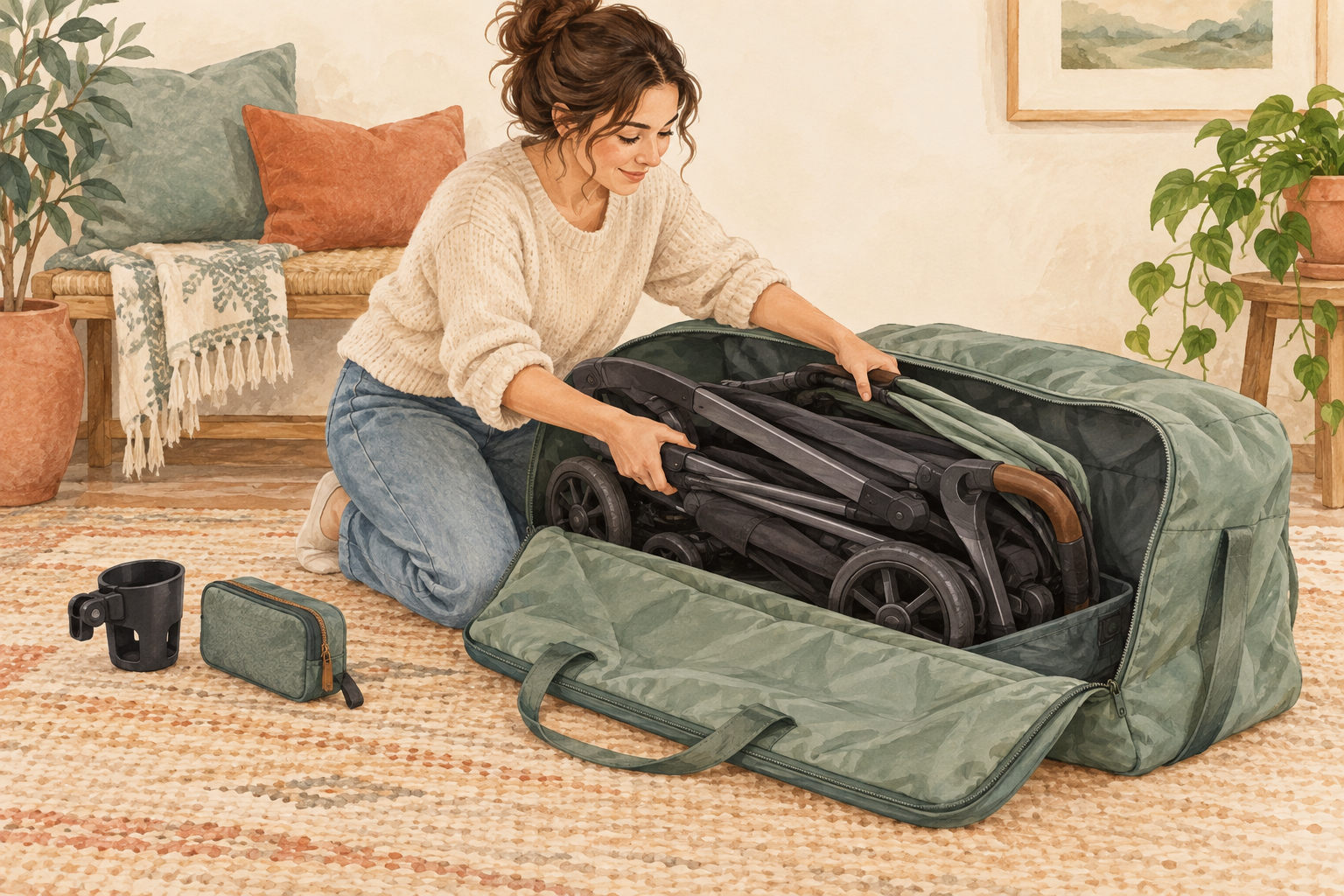
First, what does gate-checking a stroller mean?
In general, you use the stroller through the airport and hand it over at a designated point near boarding so it can travel outside the passenger cabin.
The location, tagging procedure, and return arrangements depend on the airline, airport, and flight. “Gate check” does not guarantee that every stroller can be handed over at the same place or collected at the aircraft door.
It is also different from bringing a folded stroller into the cabin. If you want cabin carriage, confirm that policy separately and prepare for the possibility of checking the stroller instead.
Before you build your plan, read your airline’s official stroller rules. Delta’s child-item guidance and American Airlines’ family travel guidance are examples of the pages to look for.
Those policies were checked on October 13, 2026. Recheck the airline operating each leg before departure, especially if your booking includes a partner airline.
Step 1: Confirm that your stroller can be gate-checked
Start with the exact stroller model, including whether it is a single, double, wagon-style, or non-collapsible design. Do not rely on another parent’s experience with a different item.
Ask whether your stroller is eligible for gate checking on your itinerary or needs to be checked at the ticket counter. If the policy includes size or weight conditions, compare them with your actual equipment.
This is also the time to ask how a car seat is handled if you are bringing one. A rule for a stroller may not answer the question about checking two pieces of child equipment.
Keep a tiny travel note
Write the essentials in a note on your phone: operating airline, flight number, stroller model, planned handover, and the collection question you still need answered.
Add the policy link. If you contact the airline, record the date and the clarification you received. You do not need pages of screenshots to be prepared.
The note is there to reduce repeated searching while you are also looking for a restroom and trying to remember which pocket holds your passport.
Step 2: Rehearse the fold at home
Set up the stroller exactly as you normally use it. Add the approved accessories you plan to take, then go through the folding instructions in the manufacturer’s manual.
Remove your belongings. Fold the stroller, secure its transport latch, and check the approved way to carry it. If you are using a bag, put it on and take it off again.
Notice the awkward moment. Is it finding the latch? Holding the bag open? Realizing that a cup holder prevents the bag from closing?
Solve that moment now. A short rehearsal is much more useful than repeatedly watching a polished demonstration video.
If two adults are traveling
Give one person responsibility for the child and the essential bag. The other can manage the stroller and any tagging conversation.
Both adults should still know the basic fold. A bathroom break, a last-minute question, or a tired child can change the division of jobs.
If you are traveling alone
Think through where your child will safely be while you fold and handle the stroller. Keep the cabin bag manageable and ask airline staff about assistance if needed.
Do not assume a “one-hand fold” means you can safely juggle the child, luggage, and stroller together. The useful test is your complete sequence, including picking it up afterward.
Step 3: Decide whether a stroller bag helps
A bag may keep detached approved accessories together and reduce dirt on the stroller. The value depends on the bag’s fit, construction, and how easily you can use it.
It is not a guarantee against damage. A thin cover and a padded bag are different products, and even padding does not remove the need to follow packing instructions.
Check the stroller and bag manufacturers’ guidance for compatibility. Make sure the closure works without forcing the frame into a position the stroller manual does not allow.
Then consider the empty bag. Where will it live while you use the stroller in the terminal? Can you retrieve it without unpacking everything?
TRY THIS AT HOME: Put the empty stroller bag where you intend to carry it. Walk across the room, retrieve it, fold the stroller, and pack it. If the sequence is irritating at home, simplify it before the airport.
Avoid treating the stroller bag as an extra suitcase. Confirm airline restrictions before putting anything besides the accepted equipment inside it, and keep valuables and essential supplies with you.
Step 4: Take a quick condition record
Before leaving home, take clear photos of the stroller’s general condition and any identifying details you may need later. A picture of the folded setup can also remind you how it fits in the bag.
Keep purchase information or the relevant model details accessible if you have them. These records are useful organization; they do not guarantee a particular airline claim outcome.
Look over the equipment while you are there. If you find a damaged latch, wheel problem, or missing part, deal with it before relying on the stroller during travel.
For a used or older stroller, check the exact model against the CPSC recall database. Follow any applicable manufacturer remedy instead of assuming that a familiar stroller is automatically ready for another trip.
Step 5: Put the child’s essentials in one removable bag
The easiest basket to empty is a basket that contains one bag.
Pack the supplies you need to keep in the cabin together. Depending on your child and journey, that might include diapers, wipes, a change of clothes, feeding supplies, a comfort item, and needed personal items.
Keep travel documents and valuables with you. A loose phone in a stroller pocket is easy to forget when someone is asking for a boarding pass.
If your stroller permits basket storage, check its load limits and use the space accordingly. Avoid hanging extra bags from handles unless the manufacturer specifically allows that arrangement.
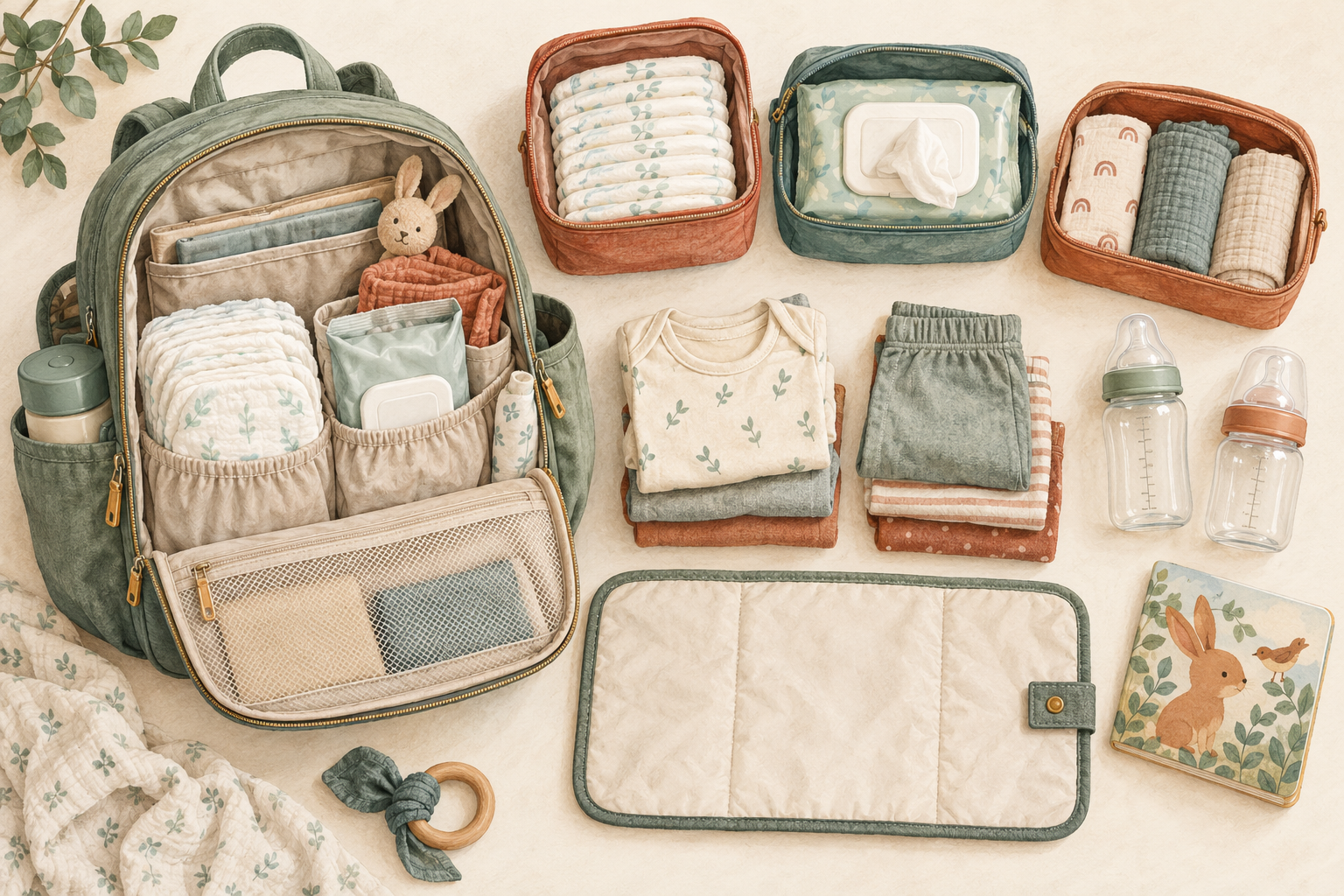
Pack for the stretch without the stroller
Think beyond the flight itself. You may need to walk from the aircraft to a collection point, wait for assistance, or manage a connection without it.
Choose a bag you can carry during that stretch. A bag that works only when suspended from the stroller is less useful once the stroller is gone.
A small delay buffer for supplies can make sense, but build it around your child’s ordinary use and the journey. You do not need to pack the entire nursery into your personal item.
Step 6: Get through security with an easy-to-empty setup
For U.S. departures, the FAA’s interview with TSA officers on flying with kids offers a useful overview of screening preparation. It was recorded in 2023, so confirm current procedures with your departure airport. Elsewhere, use the local screening authority’s instructions.
Keep small belongings contained and be ready to follow staff directions. Screening is a separate step from the airline’s gate-check process, so completing one does not resolve the other.
After security, take a minute to reset your bag. Return documents to their usual pocket, put supplies back together, and make sure nothing is left behind.
That pause can save a frantic search later. It is much easier to spot a missing item while you are still close to the place you last used it.
Step 7: Speak to the gate agent before the rush
Once you reach your gate, ask how that flight handles stroller gate checking. Do this before your group is moving toward the aircraft, if staff are available.
You need to know where to obtain the tag or claim information, where to fold and hand over the stroller, and where it is expected to return.
Listen to the instructions for that flight. An earlier trip at the same airport may have used a different procedure.
A useful script
“Hello, we’re traveling with this stroller and would like to gate-check it. Where should we tag and hand it over, and where should we collect it after landing?”
If you have a connection, add: “Will it come back to us during the connection, or is it going through to our final destination?”
Keep any claim information accessible. Check that you understand what has been arranged before walking away.
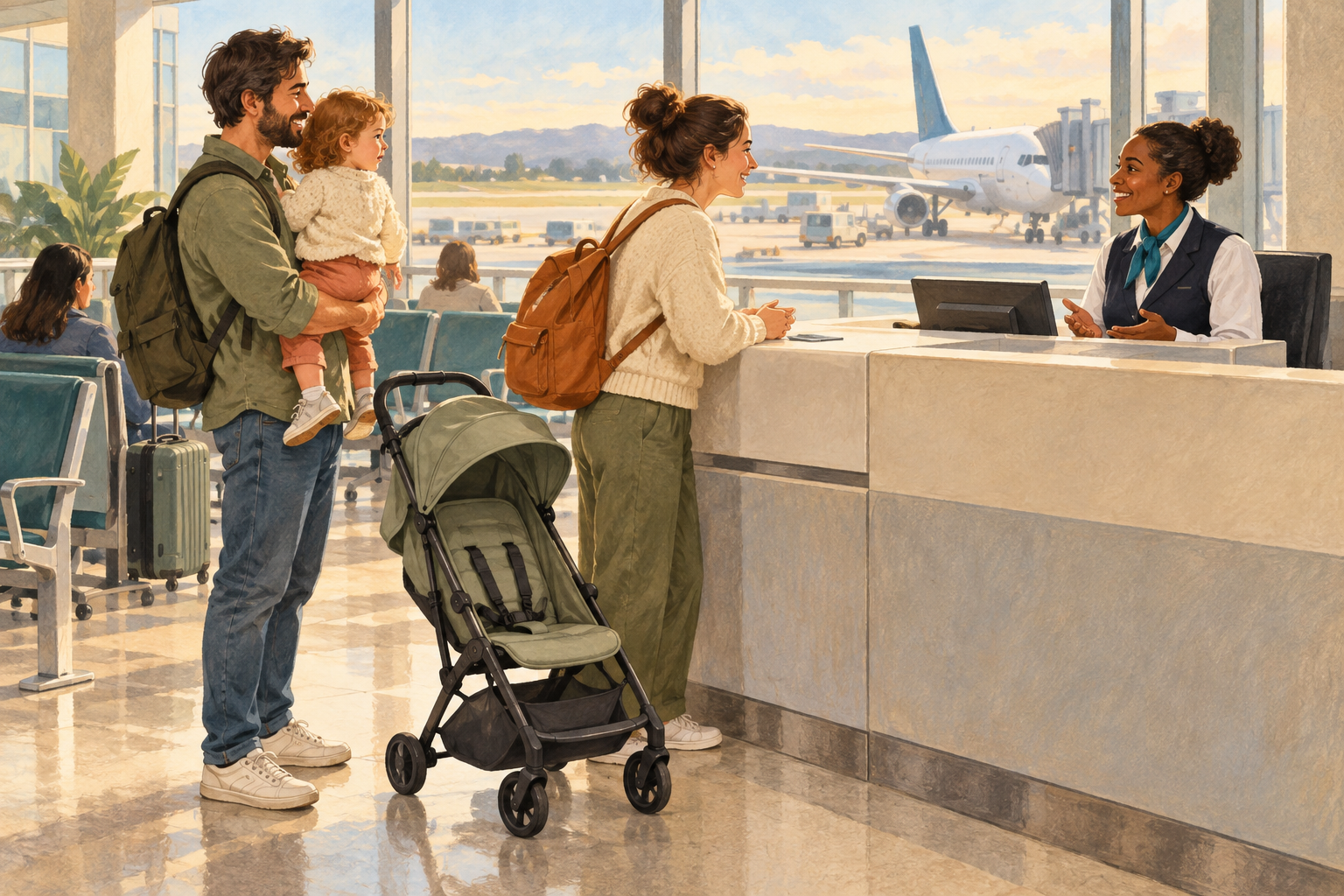
Step 8: Fold and hand over without the basket scramble
Move to the location staff direct you to use. Keep your child clear of moving parts and passenger traffic while you prepare the stroller.
Remove your essential bag, loose belongings, and any accessories that the manufacturer’s transport instructions require you to remove. Put permitted detached pieces where you planned to store them.
Fold the stroller according to its manual, engage the transport latch, and use the carrying bag if applicable. Make sure the airline’s tag remains attached and visible as instructed.
Then do a quick pocket check: phone, documents, child’s essentials, claim information. This is the moment to catch the item tucked into an organizer.
You do not need to rush into a mistake because someone is waiting behind you. Follow staff directions and ask for a moment or help when needed.
Step 9: Handle a connecting flight as its own plan
A connection is where vague assumptions become inconvenient.
Before handover, confirm whether the stroller will be returned at the connecting airport or checked onward. If it will be returned, ask where. If it will not, make sure your plan for moving through the terminal works without it.
For a partner-operated connection, check the next airline’s policy as well. Do not assume the first airline’s instructions describe every later leg.
Imagine a two-flight day
You land after the first flight with a tired toddler and a cabin bag. The next gate is some distance away.
If the stroller is being returned, you need to know where to wait or collect it. If it is checked through, waiting in the wrong place costs time without solving the problem.
The practical fix is to confirm the arrangement early and repeat the question when the tag is issued. Your plan should match what staff have actually arranged.
CONNECTION CHECK: Ask where the stroller is going, not simply whether it has been “gate-checked.” The destination and return arrangements are the parts that affect your next hour.
Step 10: Collect, inspect, and reset
After landing, follow the collection instructions you were given. If the stroller is not where you expected, ask airline or airport staff where to go before wandering between collection areas.
When you have it, move aside to open it. Check the frame, wheels, harness, brakes, and folding mechanism before putting your child in it, using the manufacturer’s instructions.
Do not force a mechanism that appears bent or jammed. If something is damaged or missing, contact the airline promptly and document what you see.
For example, Delta’s damaged and delayed baggage page explains its reporting routes. Use your own airline’s process and deadlines rather than assuming every carrier handles claims alike.
Once the stroller is ready, repack deliberately. Put the claim information away, return supplies to the bag, and take a breath before starting the next leg.
Where do you collect a gate-checked stroller?
There is no single collection point that applies to every flight. Ask when it is tagged and confirm again if the arrival instructions are unclear.
The phrase “gate checked” describes a handover arrangement, but you still need the return details for that journey.
If you cannot find the stroller, keep your claim information ready and ask staff for the correct assistance point. Do not leave the airport without understanding the reporting process if the item has not arrived.
What if the stroller is returned damaged?
Document the condition and contact the airline through its baggage process promptly. Keep the claim record and follow the instructions for supporting information.
Avoid assuming a stroller is safe to use because it still opens. A damaged restraint, wheel attachment, brake, or frame needs appropriate assessment and repair guidance.
Use the manufacturer’s support resources for questions about continued use. If you cannot use the stroller, focus first on a workable way to move your child and belongings while the reporting process is handled.
Your compact gate-check checklist
- Confirm that the exact stroller is eligible on the itinerary.
- Practice emptying, folding, carrying, and bagging it.
- Keep a condition record and model information.
- Put cabin essentials in one accessible bag.
- Ask staff about the tag, handover point, and collection point.
- Confirm whether the stroller returns during any connection.
- Keep the claim information with you.
- Inspect the stroller before using it after arrival.
Gate checking may never be the relaxing part of a holiday. It can, however, become a familiar sequence instead of a surprise task.
Get the handover and collection questions answered, keep the important bag with you, and let the stroller be one decision you have already made.
2 Comments