How to Measure Your Car Trunk for a Folded Stroller
A stroller can look compact in a product photo and still refuse to pass through your trunk opening. The usual mistake is measuring only the cargo floor—or trusting a single “cargo volume” number—then discovering that the hatch opening, wheel wells, sloped rear glass, or everyday bags take away the space you thought you had.
The reliable approach is simple: measure the smallest opening the folded stroller must pass through, measure the usable space inside the trunk, measure the stroller in the exact configuration you will load, and rehearse the whole trip with your normal cargo. This guide walks through that process without guessing whether any specific stroller fits any specific car.
The quick answer: collect three sets of measurements
To predict a fit, you need three different records: the trunk opening, the usable interior space, and the stroller’s actual folded dimensions. Write every number in the same unit—either inches or centimeters—and label the direction. A bare number such as “25” is surprisingly easy to confuse later.
- Trunk opening: narrowest width, lowest height, diagonal clearance, and load-lip height.
- Usable interior: floor width, width between wheel wells, depth at floor level, depth higher up, and height below the closed hatch or cargo cover.
- Folded stroller: maximum length, width, and height in the configuration you will actually carry, including wheels, seat, adapters, bumper bar, and any travel bag.
A fit on paper is only the first gate. The final test is whether you can load the stroller without forcing the hatch, removing something you need, or rebuilding the trunk every time you buy groceries.
Why cargo-volume numbers are not enough
Vehicle specifications often describe cargo capacity as a volume. That can help compare vehicles broadly, but volume does not describe the shape of the opening or the usable rectangular space. A deep trunk with a narrow opening may hold many grocery bags yet reject a folded frame. A hatchback may have generous height at the center but much less near the sloping glass.
Stroller dimensions create the same problem. Multiplying length × width × height gives a box volume, but a folded stroller is not a smooth box. Wheels protrude, handles curve, hinges form hard high points, and the folded package may be thicker at one end. Fit depends on whether those high points clear the smallest parts of the car.
Treat the job as a shape-and-path problem, not a volume problem. The stroller must pass through the opening, rotate if needed, rest on a stable surface, and leave enough room for the hatch to close without pressure.
What to gather before you measure
Use a locking tape measure long enough to span the trunk, a phone or notepad, removable painter’s tape, and a straight object such as a yardstick or level. A flexible sewing tape can follow curves, but it is poor at showing the straight-line clearance a rigid stroller frame needs.
Bring the vehicle key so you can move the cargo floor or rear seats only in positions you actually use. Keep child restraints installed and the rear seats in their normal position. If your household usually carries a diaper bag, reusable shopping bins, emergency kit, or pet barrier, keep those nearby for the rehearsal.
For the stroller, find the current manual and the manufacturer’s folded dimensions. Those figures are a useful starting point, but confirm them on the real stroller because accessories and folding configuration can change the outer envelope. Follow the manual for folding, wheel removal, accessory removal, and approved carry points.
Step 1: measure the trunk opening
Find the narrowest opening width
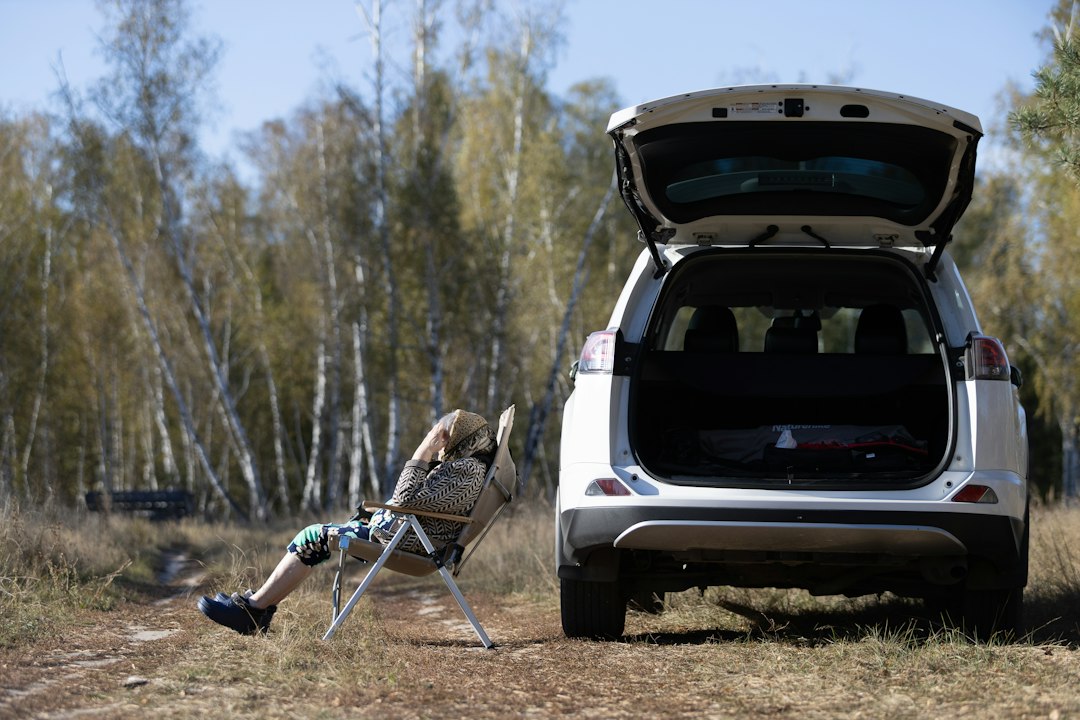
Open the hatch or trunk fully. Measure straight across the narrowest usable point the stroller must pass through. On a sedan, this may be between the hinges or trim near the top. On a hatchback or SUV, the narrowest point may be between taillight housings, latch trim, or inward-curving side panels.
Measure more than one horizontal line: near the cargo floor, through the middle, and near the top. Record the smallest number as the opening-width limit. If weather seals or soft trim compress slightly, do not count on that compression; use the clear hard-edged space.
Measure opening height and the loading lip
Measure vertically from the top of the load lip to the lowest fixed point above it. Then measure the height of the lip itself from the ground and from the interior cargo floor. A tall lip does not necessarily prevent a fit, but it changes the lift-and-tilt motion and can make a heavy folded stroller awkward to load.
For a hatchback, look at the hatch door as it closes. The trim and glass sweep through space that appears empty while the hatch is open. Never assume the full open height remains available after closing.
Check the diagonal—but do not rely on it alone
A diagonal can help a long folded stroller pass through a rectangular opening. Measure from the lower-left usable corner to the upper-right, then the opposite diagonal if the opening is asymmetric. A diagonal measurement is only meaningful if there is room inside to rotate the stroller back into its final position.
Painter’s tape can mark the narrowest points on the trim. Those marks make it easier to visualize the path and avoid comparing the stroller with a wider section of the opening by mistake.
Step 2: measure the usable interior space
Start at the cargo floor with the rear seats in their normal travel position. Measure depth from the closed-hatch plane—not merely the outer bumper—to the rear seatback. If you cannot safely close the hatch around the tape, use a straightedge held against the weather seal to represent the closure plane.
Repeat the depth measurement several inches above the floor. Many seatbacks lean toward the cargo area, so a stroller that is tall when laid flat may have less usable depth than the floor suggests. In a sedan, check whether the trunk lid hardware swings down into the cargo space.
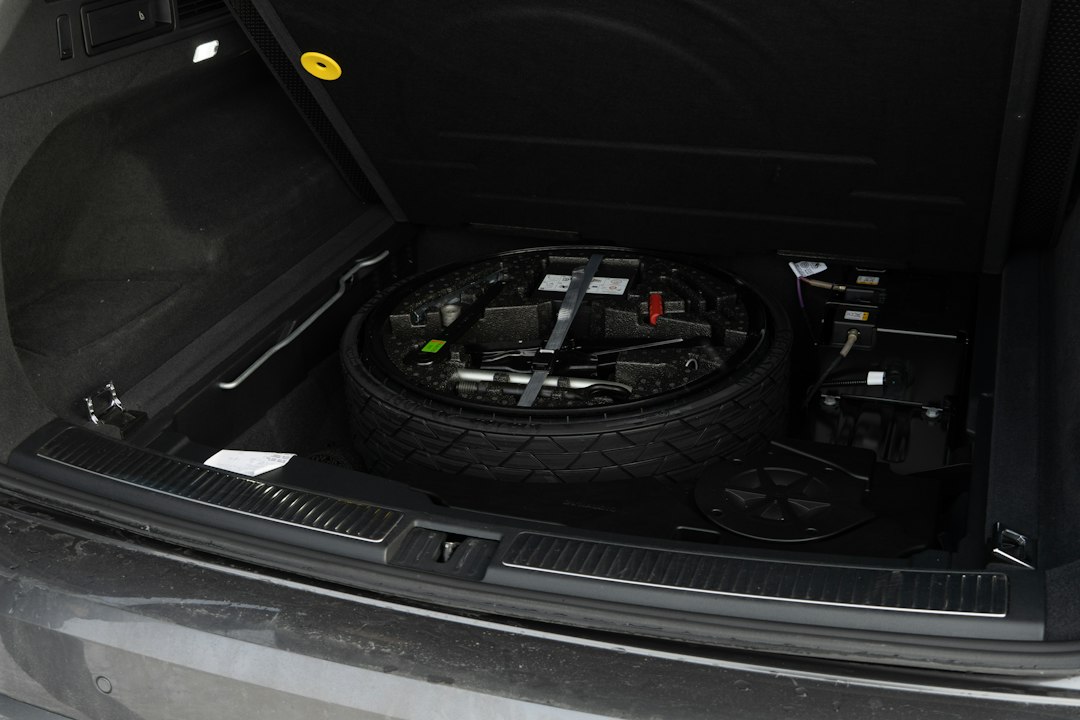
Measure total floor width and the narrowest width between wheel wells. Then measure usable height from the floor to the lowest obstruction: cargo cover, parcel shelf, hatch trim, or sloping glass. If the cargo floor has upper and lower positions, record both, but plan around the position you genuinely use.
A lower well can add valuable depth, yet it may eliminate a flat loading surface. The photo below shows why it is worth checking what sits beneath a removable cargo floor before building a plan around that space.
Step 3: measure the stroller as you will carry it
Fold the stroller according to its manual on a level surface. Engage the fold lock if it has one. Empty the basket, close the canopy if required, and place the handle in the approved folded position. Do not push flexible fabric inward to produce an unrealistic measurement.
Measure the longest point, the widest point, and the tallest point of the folded package. The widest points may be the rear wheels, not the frame. The tallest point may be a hinge, folded seat, handle, or wheel. Record each dimension with a label such as “length: axle to handle end” so you can reproduce it later.
If the manufacturer permits wheels or accessories to be removed, record two configurations: everyday fold and reduced fold. Note every loose part you would need to store. A theoretical fit that requires removing four pieces in a rainy parking lot may not be a useful everyday fit.
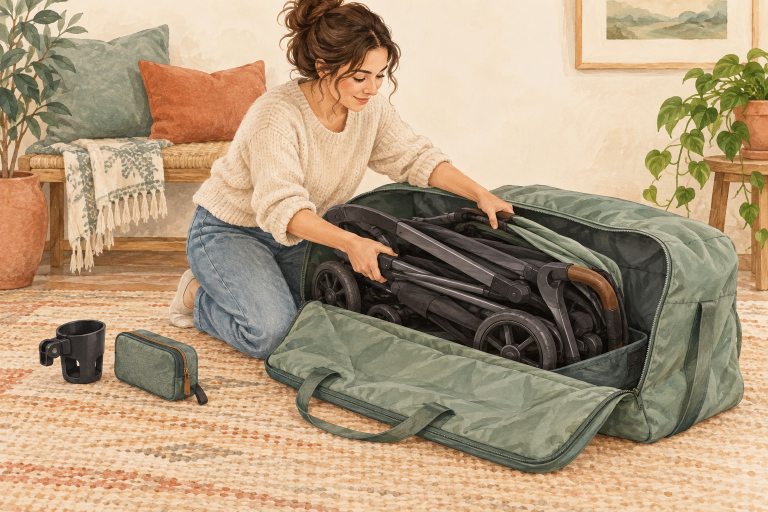
Using a travel bag? Measure the packed bag, not the bare stroller. Padding, handles, and loose fabric can add thickness. Do not assume a bag’s advertised compatibility means it will fit your car.
Step 4: compare the numbers by orientation
Sketch the trunk as a simple rectangle and the folded stroller as another. Try three realistic orientations: flat across the width, flat front-to-back, and standing or tilted if the stroller manual and vehicle layout allow stable storage. Match each stroller dimension to the corresponding opening and interior dimension.
Leave working clearance. A stroller that equals the opening width exactly is not a dependable fit because measurement error, trim curves, a slightly loose fold, or cold fingers can remove that last fraction of an inch. You also need hand space to guide the frame without scraping the vehicle or pinching fingers.
Do not “solve” a tight fit by forcing the hatch against the stroller. If the hatch touches the frame or the stroller shifts toward the latch area, change the orientation or reconsider the setup. Check the vehicle owner’s manual for cargo-loading guidance and the stroller manual for storage instructions.
A worked example using hypothetical numbers
Imagine a trunk opening that measures 38 inches wide at the floor, 34 inches at its narrowest mid-height point, and 27 inches tall. The usable interior measures 40 inches wide, 32 inches deep at the floor, 29 inches deep at seatback height, and 28 inches high below the cargo cover.
Now imagine a folded stroller measuring 31 inches long, 22 inches wide, and 13 inches high. It appears to fit flat front-to-back: 31 inches of stroller length versus 32 inches of floor depth. But the margin is only one inch, and the upper depth shrinks to 29 inches. If the stroller’s highest point sits near the seatback, the hatch may not close.
Turning the stroller across the trunk may work better because its 31-inch length is below the 34-inch narrow opening and the 40-inch interior width. The lesson is not that these figures guarantee a fit; they show why each dimension must be paired with a position and why a real loading test matters.
Step 5: rehearse with the cargo you actually carry
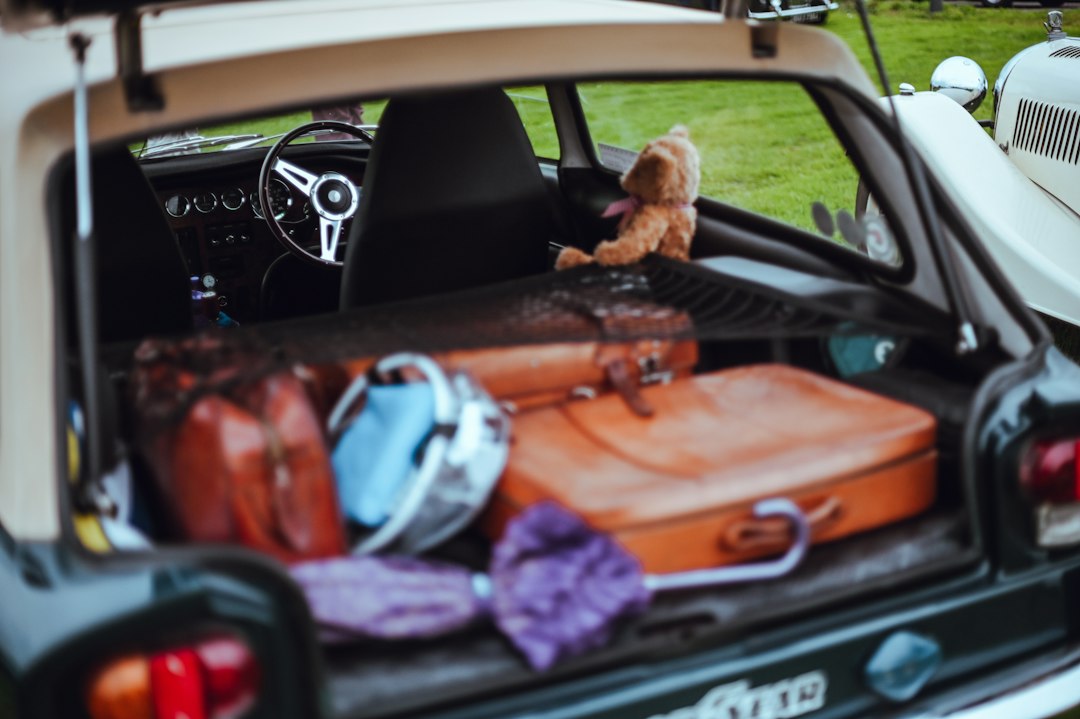
An empty-trunk fit can be misleading. Put your regular items back: diaper bag, groceries, emergency supplies, carrier, or sports gear. Then decide what must remain accessible after the stroller is loaded. If the diaper bag ends up pinned under the frame, the layout may technically fit but fail in daily use.
Load the heaviest, most rigid item in the position that gives it a stable base, following the vehicle manual. Use the vehicle’s cargo-management features as directed. Avoid loose objects on top of the stroller or anywhere they could move into the passenger area. Do not block the driver’s rear view where local rules or the vehicle manual require it.
Run three rehearsals: an ordinary errand, a grocery trip, and your fullest realistic day out. A layout that works only when the trunk is empty is not your true fit. Take a photo of the successful arrangement so another caregiver can repeat it.
Special cases that change the measurement plan
Sedans with a separate trunk
The opening is often the limiting factor. Measure around hinges, torsion bars, and the curve of the lid. Check the pass-through separately if you plan to use it, and confirm in the vehicle manual how the rear seats may be folded when child restraints are installed.
Hatchbacks and SUVs
Sloped glass and the hatch’s closing arc matter. Measure depth at more than one height and test with the cargo cover installed if you normally use it. If the stroller stands upright, confirm it remains stable and does not press on the glass or hatch.
Third-row vehicles
Measure with every seat you need in its travel position. Manufacturer cargo figures sometimes emphasize space with seats folded, but that configuration may be irrelevant to your family. Note whether headrests, seat recline, or a raised cargo floor reduce depth.
Two strollers or a stroller plus mobility gear
Measure the combined layout, not each item separately. Decide which item must come out first and whether either one traps the other. If a mobility device is part of the load, prioritize its access requirements and follow its manufacturer’s transport instructions.
The cardboard-template test
If you are shopping and cannot bring the stroller to your car, make a simple three-dimensional template from a shipping box. Build it to the manufacturer’s maximum folded length, width, and height. Add small cardboard blocks where wheels or handles protrude if you know their position.
The template will not reproduce weight, hinges, or every curve, so it cannot prove the real loading motion. It can, however, expose obvious opening and orientation problems before you arrange an in-person fit test. Label the template with the source and date of the dimensions so an older specification does not follow you into a later purchase.
Printable-style measurement worksheet
Copy this checklist into your phone. Record the date because cargo setup and stroller configuration can change.
- Vehicle and seat configuration: ______________________________
- Opening width at floor / middle / top: ________________________
- Smallest opening height: ____________________________________
- Opening diagonal(s): ________________________________________
- Load-lip height from ground / cargo floor: ____________________
- Interior depth at floor / mid-height: __________________________
- Interior width overall / between wheel wells: __________________
- Usable height with cargo cover or shelf: _______________________
- Stroller folded length × width × height: ________________________
- Accessories or wheels attached: ______________________________
- Chosen orientation and clearance at tightest point: ______________
- Everyday cargo tested: _______________________________________
- Hatch closes freely without contact: yes / no
- Successful layout photographed: yes / no
Common measuring mistakes to avoid
- Using the widest part of the opening instead of the narrowest.
- Measuring floor depth while ignoring a sloped seatback or hatch.
- Relying on cargo volume instead of matching dimensions and shape.
- Using folded dimensions from an old model year or a retailer summary without checking the current manufacturer manual.
- Measuring the stroller without the accessories you actually keep attached.
- Counting space occupied by emergency gear or a cargo cover you normally carry.
- Assuming removable wheels are a practical daily routine without rehearsing it.
- Closing the hatch against the frame to gain the last bit of room.
Before you buy: verify the stroller, not the promise
If possible, take your worksheet to the store and ask to place a floor model in your vehicle. Fold it yourself, because the ease and final size can depend on completing every step. Confirm that the exact seat, wheels, and accessories match the configuration you measured.
When shopping online, use the current manufacturer manual and specification page, then confirm the return policy before ordering. For a broader way to compare storage, carrying, and travel trade-offs, read our guide to choosing a travel stroller and our compact-versus-full-size stroller comparison.
Before using a secondhand stroller, check the model and date information and review the U.S. Consumer Product Safety Commission recall database. The CPSC also publishes information about carriage and stroller safety standards. A trunk fit does not tell you whether a stroller is appropriate for your child or free of recalls.
The final five-minute fit check
A good trunk fit is repeatable. Fold the stroller, load it, add the everyday bags, close the hatch normally, reopen it, and remove the stroller without rearranging half the car. Have another regular caregiver try the same sequence.
If the process works on an ordinary day—not just during a careful showroom test—you have useful evidence. Keep the worksheet and layout photo with your stroller notes. They will help when you change vehicles, add an accessory, compare another stroller, or plan a trip with more cargo.